

Walk into any coffee shop and the commercial espresso machine is the first thing you notice. It’s also the piece of equipment most likely to keep you up at night before opening day. Get it right, and your baristas flow through rushes without breaking stride. Get it wrong, and you’re staring at a four-figure paperweight during the morning peak while customers scroll Google Maps for the next café.
I’ve seen shops drop $15,000 on a machine they didn’t need, and I’ve seen others try to limp through 300-cup days on a single-group they bought because the price looked good. Both mistakes hurt. This commercial espresso machine guide is about not making either one.
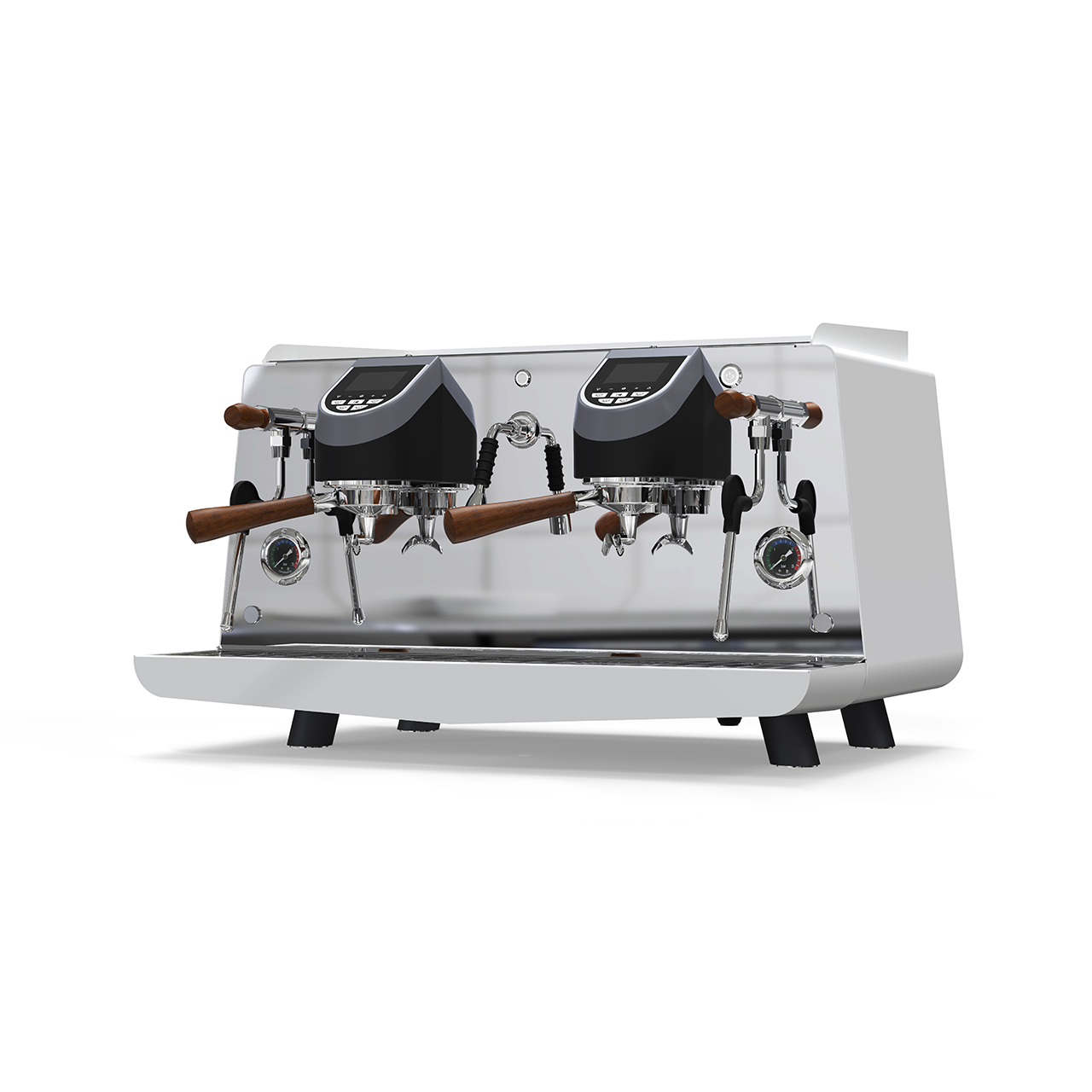
Nudof NDF-F2 — a dual-head commercial espresso machine built for high-volume coffee shops
First: forget the specs for a minute
Before you open a catalog, look at your actual situation. Three things matter more than any boiler size or pump rating:
How many drinks are you actually making? Not your business plan projection. Not your dream. Count the cups. Under 100 a day and a single-group will handle things fine. Between 100 and 300, you’ll want two group heads. Over 300, you need a serious dual-group machine with enough boiler behind it to never make a barista wait for temperature recovery.
What are you selling? If your menu is 80% lattes and cappuccinos, steam power is everything. If it’s mostly straight espresso and americanos, temperature stability at the group head matters more than how fast you can texture milk. Buy for the menu you actually have.
How much bar space is realistic? Measure it. Then subtract the grinder, the knock box, the pitcher rinser. The number that’s left is what you have for the machine. Compact shops and kiosks live or die by this math.
Single head vs double: which commercial espresso machine fits your shop
A double-group machine costs more, takes more space, and uses more power. The upside is obvious — two baristas can work at once, and you can push through rush hour without a line forming. But if you’re a 40-seat neighborhood café that does 80 drinks on a busy day, a double-group is just a flex.
I’d put it this way: if your barista regularly has two portafilters in hand and is waiting for the machine, you need a double group. If not, save the money and counter space.
That said, if you know you’ll grow into it, buying a dual-head now beats upgrading in 12 months. Something like the Nudof NDF-F2 gives you 1.5L × 2 independent boilers and 4.6kW — enough for serious throughput without going into flagship pricing territory.
Here’s the full Nudof coffee machine lineup so you can see where things land:
| Model | Heads | Boiler | Power | Width | Good for |
|---|---|---|---|---|---|
| NDF-H1 Small Shark | 1 | 1.5L | 2.0kW | 360mm | Tiny cafés, kiosks, pop-ups |
| NDF-F1 Small Flying Saucer | 1 | 2L | 2.4kW | 490mm | Neighborhood shops, mid-volume |
| NDF-TK2 Tank | 2 | 1.5L × 2 | 4.8kW | 750mm | Busy cafés, high traffic |
| NDF-F2 Large Flying Saucer | 2 | 1.5L × 2 | 4.6kW | 760mm | Multi-type stores, rush-heavy |
| NDF-G2 Commander | 2 | 1.5L × 2 | 4.8kW | 900mm | Specialty flagship shops |
Boilers: the thing most buyers don’t think about until it’s too late
The boiler setup determines whether your shot #50 of the morning tastes the same as shot #3. Here’s the short version of what you’ll find:
Single-boiler machines use one boiler for both extraction and steam. You can’t brew and steam at the same time. For a commercial setting, this is unusable. Save single boilers for home counters.
Heat exchanger (HX) machines run a tube through a big steam boiler to heat the brew water. You can brew and steam simultaneously, but the brew temperature drifts during heavy use. A good barista can work around it — flushing water between shots, timing things — but it’s extra mental load during a rush. Fine for mid-volume, not ideal if consistency is your brand.
Multi-boiler systems give each group head and the steam wand their own dedicated boiler. Temperature stays locked in back-to-back-to-back. This is what you want. Every Nudof model runs a T3 multi-boiler setup with PID control and multi-point probes that keep things within ±1°C. No flushing, no guessing, no excuses.
If you’re comparing specs, look for: boiler material (copper holds heat well, stainless resists scale), capacity, and whether the temperature control is PID rather than a basic thermostat. Nudof machines check all three.
Pump: the difference between “commercial” and “looks commercial”
Vibration pumps are loud, wear out in a few years, and need a regulator to step the pressure down to 9 Bar. They belong in home machines. If something marketed as “commercial” has a vibe pump, walk away.
Rotary pumps run quiet, last a decade or more, and deliver 9 Bar directly. Every Nudof espresso machine uses a commercial-grade rotary pump because there’s no other way to do it for a shop that expects the machine to run all day, every day.
Steam: don’t find out during the morning rush
If lattes and cappuccinos are half your menu, steam performance is half your bottleneck. What matters:
Aim for at least 1.3 Bar of steam pressure with a 4-hole tip. Two-hole wands texture slower and less evenly. More importantly, the steam pressure needs to hold — some machines will give you three good pitchers then drop off while the boiler catches up. You don’t want to discover that on a Saturday.
The Nudof dual-head machines (TK2, F2, G2) run a 10L steam boiler at 3,000W. That’s enough to texture milk continuously through a rush without waiting for recovery. The single-head models have proportionally smaller steam boilers but still maintain 1.3 Bar — enough for a single barista working a steady pace.
Features you’ll actually use every day
Some specs look great on a brochure and never matter in real life. These ones do:
Pre-infusion matters. Low-pressure water soaking the puck before full pressure hits reduces channeling and gives you a more even extraction. It’s standard on all Nudof machines, not an upsell.
Temperature display matters. A screen showing real-time brew and steam temperature means your barista can catch a problem before it ruins a drink. The digital displays on Nudof machines show real-time milk temp too, which is genuinely useful during service. The NDF-G2 Commander goes further — dual 3.5-inch independent touchscreens, one per group head.
Programmable dosing matters less for quality but more for consistency across different baristas and shifts. Set the volume, push the button, same shot every time. Nudof has this across the board.
Cleaning access matters a lot. If your barista has to move the machine to clean it properly, it won’t get cleaned properly. Front-access drain and flush, paired with stainless anti-scratch panels, means daily cleaning takes two minutes instead of being a production. Nudof designs for this.
What should you actually spend?
There’s no magic number, but here’s a rough map:
Entry commercial machines ($2,000–4,000) are mostly single-group HX units. They work for low-volume shops but you’ll feel the limits as you grow.
The mid-range ($4,000–8,000) is where things get interesting. Dual-group, multi-boiler, rotary pump, PID control — the tech that makes a difference — becomes standard here. Most independent cafés live in this bracket.
Above $8,000 you’re largely paying for the badge. Italian heritage brands charge a premium that, according to specialty coffee industry data, doesn’t always translate to better coffee. The engineering underneath is similar.
Nudof sits in an interesting spot: mid-range pricing with premium features across the board. T3 multi-boiler, rotary pump, PID, pre-infusion, LCD displays — all standard, not optional extras. The difference is factory-direct pricing from Guangzhou instead of the distribution markup that European brands carry. CE certified, with ETL in progress for North American markets.
After-sales: ask before you need it
Every espresso machine needs parts eventually. Group gaskets wear. Shower screens clog. Pump seals go. Before you buy, know the answers to these:
Does the manufacturer stock spares? Will you wait weeks for a group gasket or do they ship in days? Is there actual technical documentation — exploded diagrams, maintenance schedules — or just a quick-start guide? And when something goes wrong at 7am on a Tuesday, who do you call and how fast do they answer?
Direct-from-manufacturer support has one big advantage: no distributor in the middle. Nudof provides 12-month warranty with direct factory support, and because they manufacture in-house, parts availability isn’t dependent on a third-party warehouse on another continent.
The short version
Pick your commercial espresso machine based on real volume, real menu, and real counter space. Multi-boiler + rotary pump + PID control is the baseline for anything calling itself commercial. Buy the steam capacity you need for your busiest hour, not your average one. And don’t pay Italian brand money when the engineering — not the badge — is what hits the cup.
Nudof’s five machines span from the 360mm NDF-H1 for tiny cafés to the 900mm NDF-G2 Commander for destination specialty shops. Same architecture across the board, just scaled to your volume. Factory-direct pricing that makes room in the budget for a proper grinder, filtration, and training — all of which matter at least as much as the machine itself.