

Table of Contents
The Lineup at a Glance
| Model | Heads | Type | Best For |
|---|---|---|---|
| NDF-H1 “Little Shark” | 1 | Compact | Small cafes, kiosks, low-volume specialty shops |
| NDF-F1 “Small Saucer” | 1 | Standard | Solo barista cafes, quality-focused independents |
| NDF-E21 “Gemini” | 2-in-1 | Tea+Coffee | Combo shops, cafes adding tea, tea shops adding coffee |
| NDF-F2 “Big Saucer” | 2 | Standard | Busy cafes, restaurants with bar service |
| NDF-TK2 “Tank” | 2 | Heavy-Duty | High-volume chains, hotel breakfast buffets, catering |
| NDF-G2 “Commander” | 2 | Flagship | Specialty coffee bars, competition venues, flagship stores |
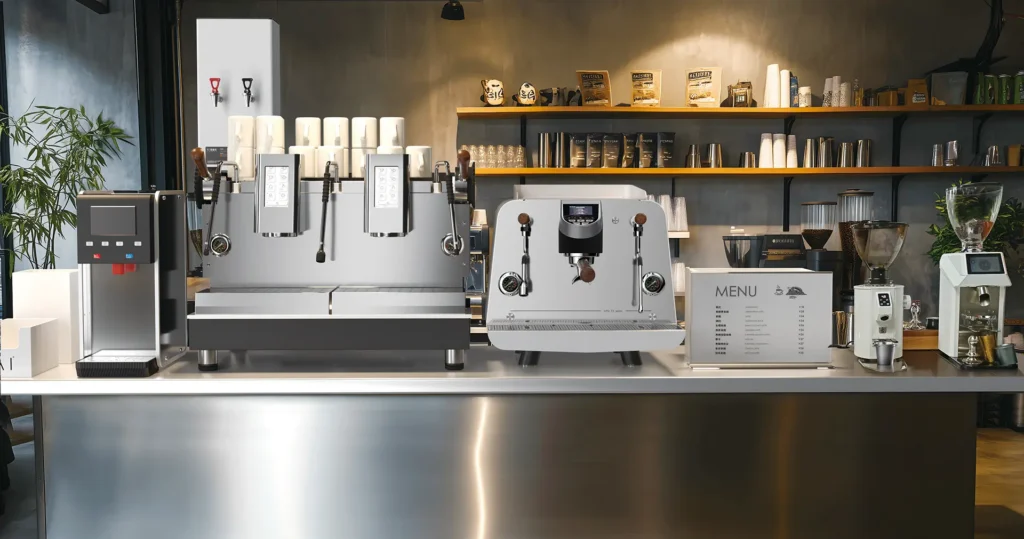
If you’re looking at Nudof’s commercial espresso machine lineup, there’s a reason there are six models instead of two or three. Each machine is built for a specific type of cafe operation, from the solo barista running a neighborhood coffee window to the high-volume chain pushing 400 cups through a morning rush.
Single-Group Machines: H1 vs F1
Both are single-group commercial espresso machines that fit on a standard counter. The difference is what you’re asking the machine to do.
NDF-H1 “Little Shark” is Nudof’s entry point. It’s compact, around a foot and a half wide, with a commercial-grade steam wand and pre-infusion that you’d normally only see on bigger machines. Pre-infusion wets the coffee puck at low pressure before full extraction starts, and it makes a real difference in shot consistency. If you’re doing 30 to 60 cups a day, this commercial espresso machine will never be the bottleneck.
Who it’s for: a coffee window, a small specialty cafe where the owner is also the barista, a restaurant that wants to add serious espresso to their dessert menu without overhauling the kitchen.
NDF-F1 “Small Saucer” steps up with PID-controlled temperature stability and multi-boiler architecture. A dedicated brew boiler keeps extraction temperature locked in while a separate steam boiler handles milk. On the H1, steaming and brewing share a boiler. On the F1, they never interfere. If you’re doing back-to-back orders, this commercial espresso machine delivers the same shot quality from the 10am cortado to the 3pm latte.
Who it’s for: an independent cafe doing 80 to 150 cups a day, where one barista works the machine all shift.
The Wildcard: E21 “Gemini” — Dual Tea and Coffee System
The E21 is the odd one out in the commercial espresso machine lineup. It’s a dual-system tea and coffee all-in-one. Two independent boilers, each with their own group head: one side pulls espresso, the other dispenses hot water for tea or Americanos at adjustable temperatures (85°C for green tea, 95°C for black).
For a cafe doing serious volume in both coffee and tea, or a bubble tea shop adding a coffee program, the E21 is essentially two machines for the footprint of about one and a half.
Two-Group Machines: F2 vs TK2 vs G2
This is where the decision gets harder because all three commercial espresso machines handle serious volume. The differences are in what you value: speed, durability, or control.
NDF-F2 “Big Saucer” is the standard-bearer with multi-boiler and independent group control. Barista A pulls a ristretto on the left group while Barista B dials in a new single-origin on the right, neither affecting the other. Built for peak-hour throughput: 200 to 350 cups a day, two baristas, two groups.
NDF-TK2 “Tank” earns its nickname with a reinforced chassis and high-capacity boiler rated for roughly double the duty cycle. This is the commercial espresso machine for a hotel breakfast buffet running four hours straight, or a chain store pulling shots nonstop from 7am to 4pm. If your question is “will this machine still work perfectly five years from now running 400 cups a day,” the TK2 is your answer.
NDF-G2 “Commander” is Nudof’s flagship. Advanced flow profiling lets you program pressure curves per recipe. Independent multi-boiler means each group has its own dedicated brew boiler plus a shared steam boiler. Built for specialty coffee bars, competition venues, and flagship stores where espresso is the reason customers come.
How to Decide in 5 Minutes
- How many baristas work at the same time? One = single group (H1 or F1). Two = two-group (F2, TK2, or G2).
- Do you serve serious tea alongside coffee? Yes and want one machine = E21. Coffee-only = skip the E21.
- How many cups per day? Under 100 = H1 or F1. 100–350 = F2. Over 350 = TK2. Quality-obsessed = G2.
- Who’s operating the machine? Owner-barista passionate about coffee = G2. Shift staff with varying experience = F2 or TK2.
The Nudof Difference Across All Six Models
- Multi-boiler architecture throughout. Even the entry-level H1 uses independent boilers. No single-boiler compromise anywhere in the lineup.
- Commercial-rated components. Pump duty cycles, boiler materials, and group head construction are all rated for commercial daily volumes.
- Pre-infusion on every machine. From the H1 to the G2, pre-infusion is standard, not a premium feature you pay extra for.
- Dry steam. All Nudof steam wands produce high-temperature vapor with minimal water content. Dry steam makes the silky, paint-like texture you see on competition-level latte art. Every model in the lineup delivers it.
Bottom Line
There’s no “best” Nudof coffee machine. There’s the one that fits your volume, your bar layout, your barista skill level, and your menu. The H1 for a neighborhood window, the F2 for a busy independent, the TK2 for a chain that can’t afford downtime, the G2 for a shop where espresso is the whole point, and the E21 for the shop that refuses to choose between coffee and tea.
Figure out your daily cup count, count your baristas, and the lineup sorts itself out.
Browse the full commercial espresso machine lineup at nudof.com or contact us for side-by-side specs and pricing. Also see our tea brewer guide and milk tea machine buying guide.
References: Specialty Coffee Association · World Coffee Portal