










Table of Contents
An espresso machine isn’t a refrigerator. You can’t plug it in and ignore it for five years. The water sitting in the boiler, the coffee oils coating the group head, the milk residue in the steam wand: all of it accumulates, and all of it eventually shows up in the cup.
Espresso machine maintenance doesn’t take long. What takes long is fixing a machine that wasn’t maintained. Here’s what to do and when.
Daily (5 minutes at close)
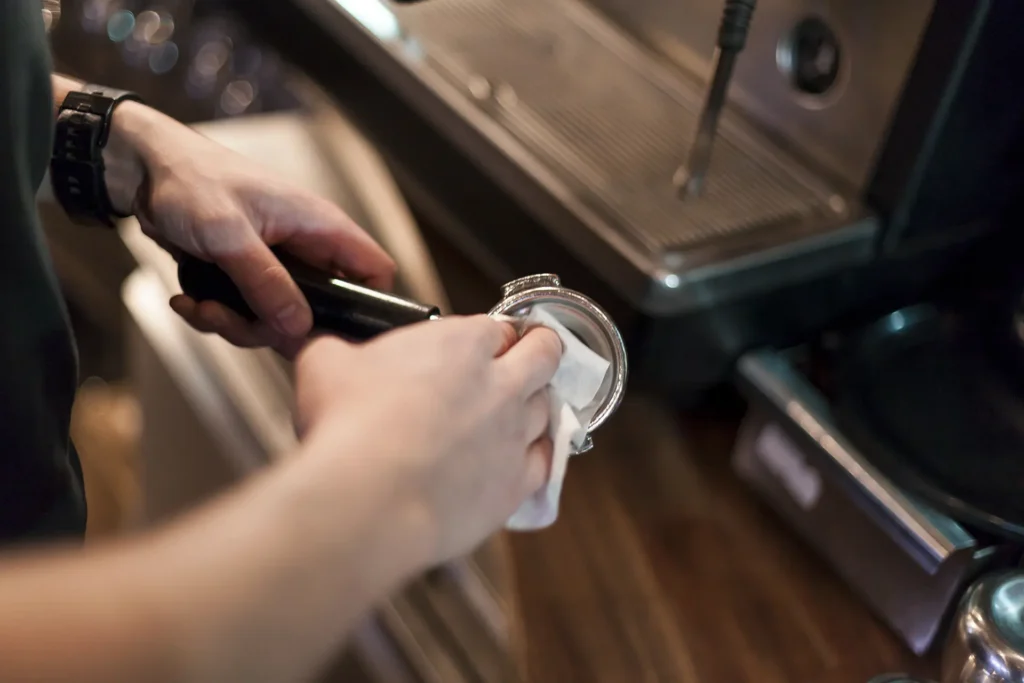
Backflush with water. After the last shot of the day, put the blind filter basket in the portafilter, lock it into the group head, and run the pump for 10 seconds. Release. Do this three times. This pushes hot water backward through the brew path and flushes out loose coffee particles.
Brush the group head gasket. The rubber gasket that seals the portafilter collects coffee grit around its edge. A stiff nylon brush (specifically a group head brush, ¥30) run around the rim removes what the backflush misses. Do this gently. You’re cleaning rubber, not scrubbing a grill.
Purge and wipe the steam wand. After every milk drink during the shift you should be purging the wand for a second and wiping it with a damp cloth. At close, do one thorough purge (5 seconds of full steam), then remove and soak the steam tip in warm water for 15 minutes. Milk protein hardens inside the tip holes and reduces steam pressure. A blocked tip makes it impossible to get microfoam.
Wipe all surfaces. A damp microfiber cloth. No spray cleaners directly on the machine; spray on the cloth, then wipe. Spray can get into ventilation grilles and electronics.
Weekly Espresso Machine Maintenance (15 to 20 minutes)
Backflush with detergent. Same procedure as the daily backflush, but with espresso machine cleaning powder (Puly Caff, Cafiza, or equivalent, about ¥80 for a jar that lasts months). Put a small scoop in the blind filter basket, lock in, run 10 seconds, sit for 10 seconds, run 10 seconds. Repeat 3 to 5 times until the water coming out during the release phase runs clear, not brown. Then do two more cycles with plain water to rinse.
Soak portafilters and baskets. Remove the basket from the portafilter. Soak both in hot water with a teaspoon of detergent for 20 minutes. Scrub the basket with a soft brush. Rinse thoroughly. Coffee oils baked onto a portafilter over weeks become rancid and every shot picks up a bitter undertone that you’ll spend days trying to diagnose from your beans or grind.
Deep clean the steam wand. Remove the tip. Inspect each hole against a light source; if any are partially blocked, use a steam wand cleaning needle (¥20) to clear them. Soak the tip in hot water with detergent. Wipe down the full length of the wand arm. If the rubber insulation on the wand has any cracks or tears, replace it. A torn wand cover is a bacteria trap.
Check the drip tray drain. Pull the drip tray cover, empty and rinse the tray. If your machine drains to a floor drain, check that the drain hose isn’t kinked or clogged with coffee grounds. A backed-up drip tray overflows during rush and nobody notices until someone slips.
Check water softener / filter indicator. Hard water scale is the number one cause of espresso machine failure. If you’re on a replaceable water filter cartridge, check the flow rate indicator. If it’s beyond the manufacturer’s rated capacity, swap it. Scale damage is cumulative and repair is expensive.
Monthly Maintenance (30 to 45 minutes)
Inspect and lubricate the group head gasket. Remove the portafilter, run your finger around the group gasket. If it feels hard, cracked, or you see significant wear, replace it (a new gasket is ¥50 to ¥150 and takes 5 minutes). Even if it looks fine, apply a thin film of food-grade silicone lubricant (Molykote 111 or equivalent, ¥100/tube) to the gasket surface. This keeps it pliable and extends its life by months.
Remove and clean the shower screen. Unscrew the shower screen (the metal disc above the group head where the water comes out). Soak it in hot water with detergent for 20 minutes. Scrub gently with a soft brush. Inspect the holes: if any are enlarged or the screen is warped, replace it (¥30 to ¥80). A deteriorated shower screen distributes water unevenly, causing channeling in the puck.
Check pump pressure. Most commercial machines have a pressure gauge. At idle, the pump should deliver 9 bars during extraction. If you’re seeing 7 to 8 bars with a properly dosed and tamped puck, the pump may be wearing or the over-pressure valve needs adjustment. A 1-bar drop is enough to change extraction and make consistent recipes impossible.
Descale the boiler (every 2 to 3 months, or monthly in hard water areas). This depends on your water hardness. If your water is over 100 ppm total dissolved solids, descale monthly. Use a commercial espresso machine descaler (not vinegar, which doesn’t fully dissolve coffee scale and leaves odor). Follow the manufacturer’s descaling procedure. If your machine has a dedicated descaling mode, use it. If not, you’re manually running descaler through the boiler, letting it sit, then flushing thoroughly.
Check all seals and gaskets. Run the machine with the covers off (if you’re comfortable) or have a tech do this: look for any water droplets, steam leaks, or moisture around boiler fittings, group head connections, and water lines. A small leak that drips onto wiring is an expensive repair if caught late.
What Happens When You Skip This Stuff
Skipping daily cleaning: after about two weeks, your shots taste ashy. You blame the roast. It’s not the roast. It’s a month of baked-on coffee oil in the group.
Skipping steam wand cleaning: milk foam becomes impossible. Your barista overcompensates by aerating longer, which scalds the milk. Customers complain about burnt-tasting lattes. It’s a blocked steam tip with three-week-old milk protein.
Skipping water filter changes: scale builds inside the boiler. The heating element runs longer to reach temperature, your electricity bill creeps up, and one day the machine trips the circuit breaker mid-rush. The repair bill is ¥5,000 to ¥8,000 for a descale that could have been ¥200 in filters and 30 minutes a month.
Quick-Reference Checklist
| Frequency | Task | Time |
|---|---|---|
| Daily | Backflush with water (3×), brush gasket, purge/wipe wand, wipe surfaces | 5 min |
| Daily | Soak steam tip 15 min | (overnight or during close) |
| Weekly | Backflush with detergent, soak portafilters, deep clean wand, drip tray, check filter | 15-20 min |
| Monthly | Lube gasket, clean shower screen, check pressure, check seals | 30-45 min |
| Every 2-3 months | Descale boiler (monthly in hard water) | 45-60 min |
The daily and weekly stuff: you or a trained barista can do it. The monthly descale and seal check: if you’re not confident working with the covers off, have a tech do it. A service call once a quarter (¥500 to ¥1,000) is cheaper than a breakdown.
Nudof espresso machines (NDF-H1, NDF-F1, NDF-G2, NDF-F2, NDF-TK2) are built with front-access service panels, tool-free group head components, and detachable steam wands for easy daily and weekly maintenance. Browse the lineup at nudof.com.